Why BPM Detectors Return Half or Double Tempo (Real DnB & Trap Tests + Fixes)
The "Octave Error" Every DJ & Producer Runs Into
Drop a 174 BPM Drum & Bass track into almost any BPM detector—whether Rekordbox, Serato, Traktor, Ableton, or an online analyzer—and it will frequently report 87 BPM. Drop a 70 BPM Trap ballad and it may report 140 BPM.
This is not a broken algorithm; it is called a metrical octave error. Mathematically, 87 BPM and 174 BPM share the exact same beat grid—one simply counts every second pulse. Because most beat-tracking algorithms apply a perceptual prior favoring 80–150 BPM (where most pop, hip-hop, and house songs live), very fast genres (160–180 BPM) get folded in half, and very slow genres (60–75 BPM) get doubled.
Real Hands-On Test: 174 BPM DnB Folded to 87 BPM
We synthesized a 16-second 174 BPM Drum & Bass breakbeat (dnb-174bpm-d-minor.wav) and a 140 BPM half-time Trap groove (trap-140bpm-a-minor-halftime.wav) and ran both through BPMKeyFinder in Chrome (Essentia.js WebAssembly, 100% local):
| Track | True Groove Tempo | Raw Essentia.js Reading | Analysis Time | Action Needed |
|---|---|---|---|---|
dnb-174bpm-d-minor.wav | 174 BPM | 87 BPM (exact ÷2) | 607 ms | Click ×2 → 174 BPM |
trap-140bpm-a-minor-halftime.wav | 140 BPM (70 half-time) | 140 BPM | 807 ms | Keep 1× (DAW) or click ÷2 → 70 BPM |
house-126bpm-f-minor.wav | 126 BPM | 126 BPM | 752 ms | Exact match (1×) |
lofi-85bpm-c-major.wav | 85 BPM | 86 BPM | 612 ms | Within ±1 BPM |
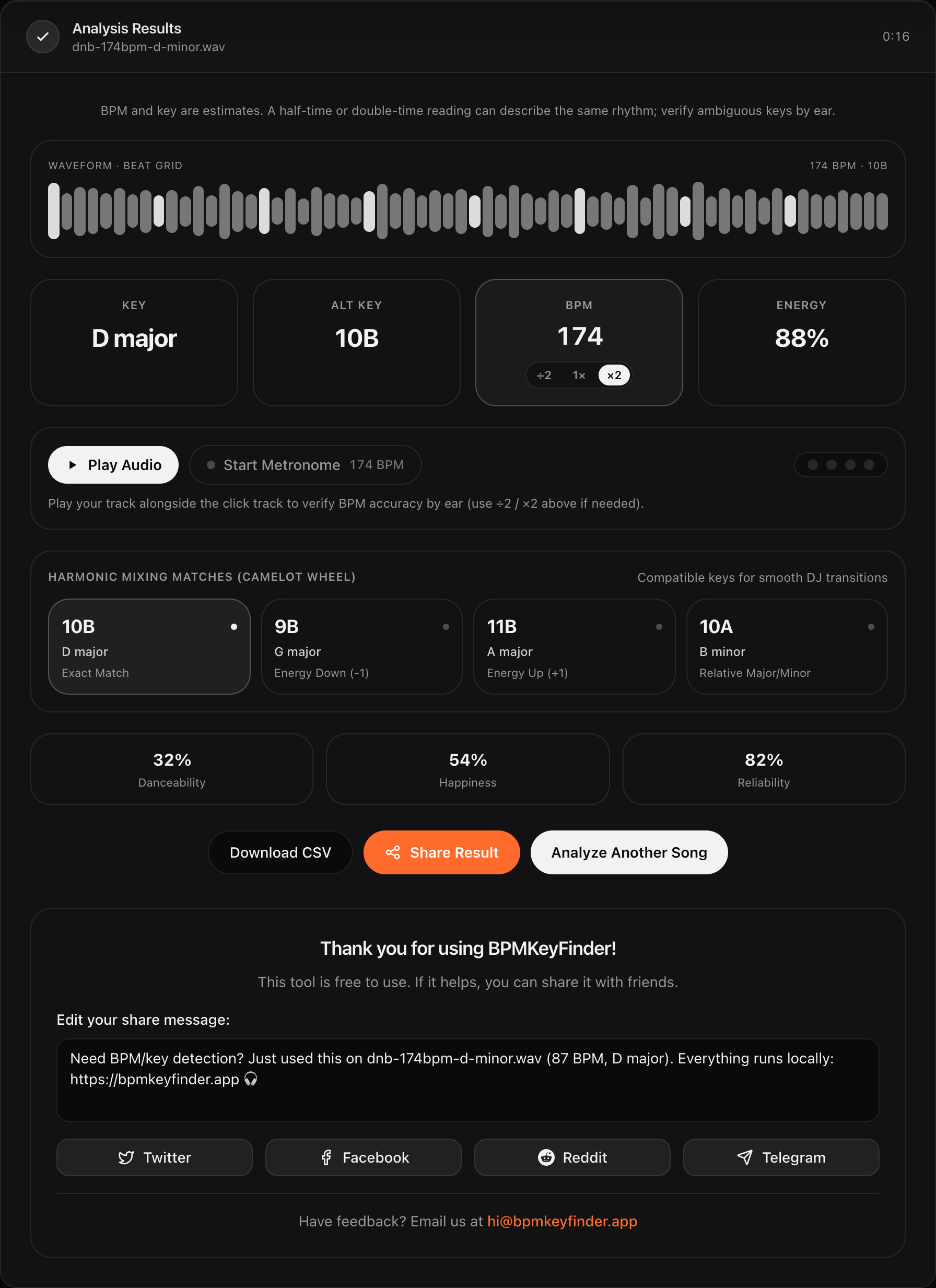
Look at what happened on dnb-174bpm-d-minor.wav: Essentia.js returned 87 BPM—precisely half of 174. Clicking the ×2 toggle right under the BPM readout immediately doubled both the displayed tempo and the built-in verification metronome to 174 BPM:
3-Step Verification Method (Takes 10 Seconds)
Whenever a detected BPM looks suspiciously slow or fast, follow this exact checklist:
1. Listen to the Snare / Backbeat Position
- Standard 4/4 pop, rock, house, or DnB: Kick hits on beats 1 & 3, snare hits on 2 & 4. If your head nods twice per bar on the snare, you are counting at the full tempo (e.g., 174 BPM for DnB).
- Half-time Trap / Dubstep: Snare lands only on beat 3 of a 140 BPM bar. Producers usually set their DAW to 140 BPM (so 1/16 hi-hat rolls are easier to program), while dancers feel the pulse at 70 BPM.
2. Toggle ÷2 / 1× / ×2 Against the Built-In Metronome
On BPMKeyFinder, press Play Audio and Start Metronome together. Toggle between ÷2, 1×, and ×2—the right setting will lock cleanly onto every kick/snare hit without feeling rushed or sluggish.
3. Sanity-Check Manually with Tap Tempo
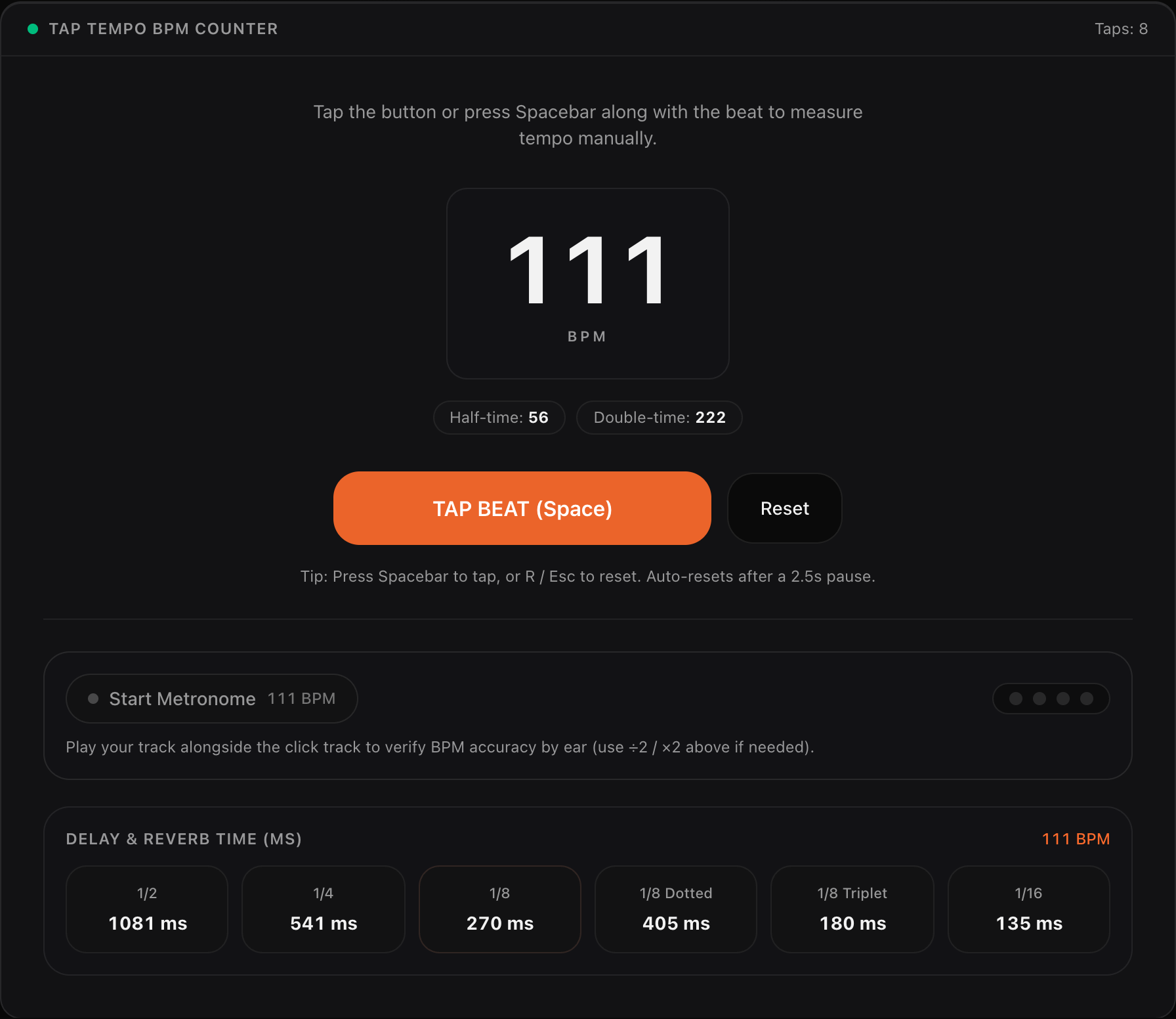
If a track has rubato, swung drums, or sparse percussion, switch to our Online Tap Tempo tab and tap your Spacebar for 8 steady beats. It shows your live BPM alongside Half-time and Double-time readouts plus synced delay milliseconds:
When Should You Choose Half-Time vs. Double-Time?
| Use Case | Recommended Tempo Setting | Why |
|---|---|---|
| DAW Production (Trap / Drill / Dubstep) | Double-time (140–150 BPM) | Cleaner piano-roll grid for 1/16 & 1/32 hi-hat rolls |
| DJ Crate Organization | Match your crate convention | Prevents Rekordbox/Serato Sync from jumping 2× speed |
| Delay & Reverb Sync | Either works (just halve/double note value) | 1/4 note at 140 BPM = 1/8 note at 70 BPM (428.6 ms) |
| Workout / Running Playlists | Perceived step cadence (120–180 SPM) | Matches real footstrike pace |
Need to convert your verified BPM into exact DAW delay times? Jump straight to our BPM to MS Calculator.
About BPMKeyFinder Audio Team
Audio engineering and DJ workflow specialists building fast, privacy-first browser tools.
https://bpmkeyfinder.app