
Camelot Wheel Harmonic Mixing Guide: Hands-On Rules, Key Chart & Real Browser Tests
Why Harmonic Mixing Matters (and What Actually Causes Clashes)
Even when two tracks are beatmatched to the exact decimal BPM, blending an F# minor synth lead over a G minor vocal creates immediate dissonance. Their scales only share 2 of 7 notes, so overlapping melodies fight each other on a club sound system.
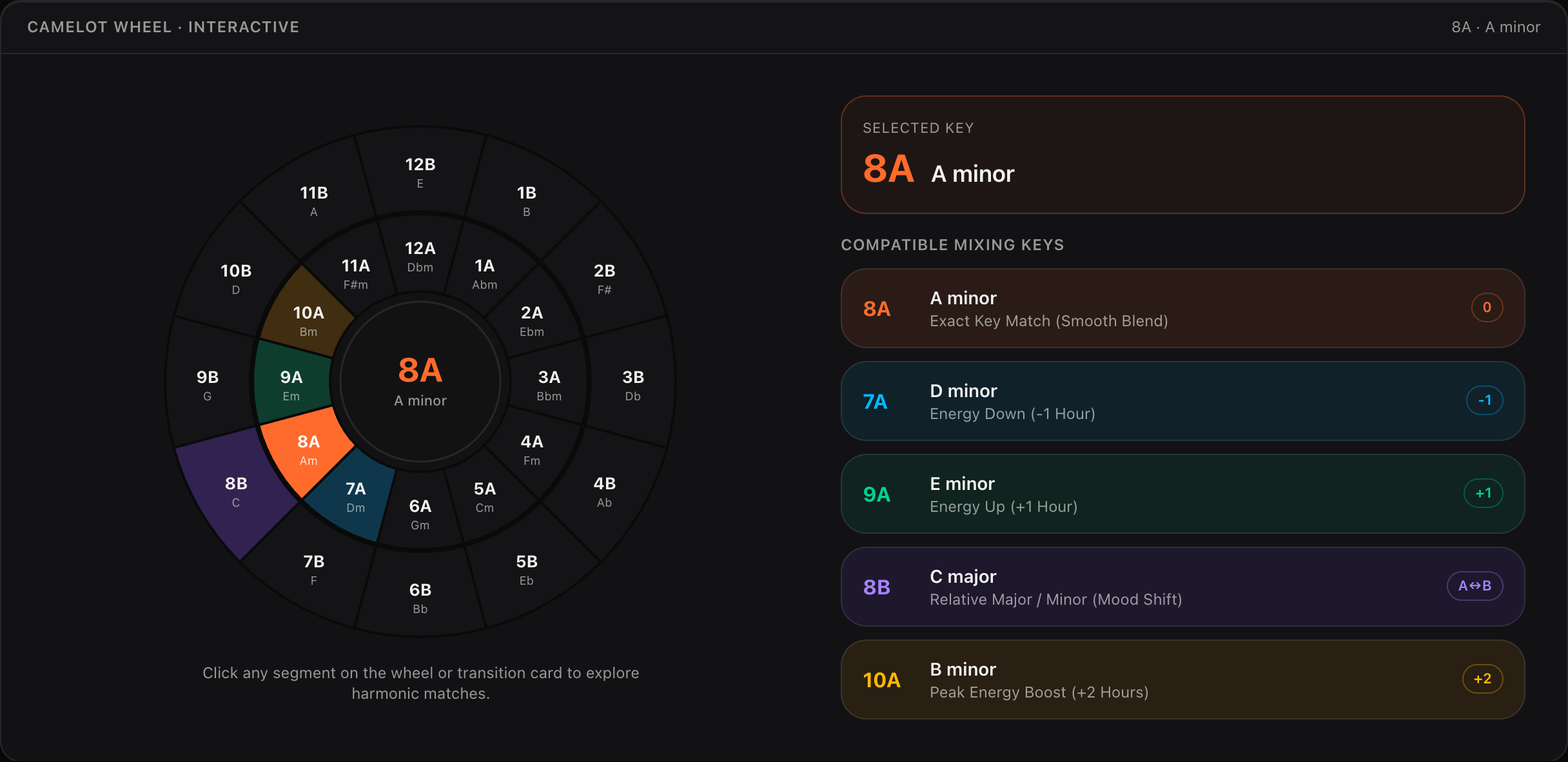
The Camelot Wheel solves this by remapping the Circle of Fifths onto a 12-hour clock:
- Inner Ring (A) = Minor keys (e.g.,
8A = A minor,4A = F minor) - Outer Ring (B) = Major keys (e.g.,
8B = C major,7B = F major)
Every adjacent number on the wheel shares 6 out of 7 scale notes, letting you plan long blends, vocal mashups, and peak-time lifts without memorizing sharps or flats.
The 5 Proven Camelot Transitions
Assuming your current track is 8A (A minor)—as shown in our Interactive Camelot Wheel screenshot above—here is what each move sounds like in a live set:
| Move | Target Key | Musical Relation | Best Used For |
|---|---|---|---|
| Same Code (0) | 8A → 8A (A minor) | Identical scale | 32-bar long blends, acapella overlays, mashups |
| Energy Up (+1) | 8A → 9A (E minor) | Up a fifth (+7 semitones) | Gradual lift building toward peak hour |
| Energy Down (-1) | 8A → 7A (D minor) | Down a fifth (-7 semitones) | Cooling down, warm-up sets, after-hours flow |
| Relative Switch (A↔B) | 8A → 8B (C major) | Relative major/minor (same notes!) | Shifting mood from dark/minor to bright/major |
| Energy Boost (+2) | 8A → 10A (B minor) | Whole-tone jump (+2 semitones) | Instant hands-in-the-air peak-hour drop |
Pro tip: For
+2energy boosts, avoid overlapping sustained melodic pads for 16 bars. Mix on a percussive breakdown or drum loop so the key jump hits cleanly on the downbeat.
Hands-On Test: Measuring Key & Camelot Codes Locally in Chrome
To verify how fast and reliable browser-based key analysis is in practice, we synthesized 16-second test tracks at known tempos and tonal centers and ran them through BPMKeyFinder (Essentia.js WebAssembly, 100% local in Chrome—0 bytes uploaded).
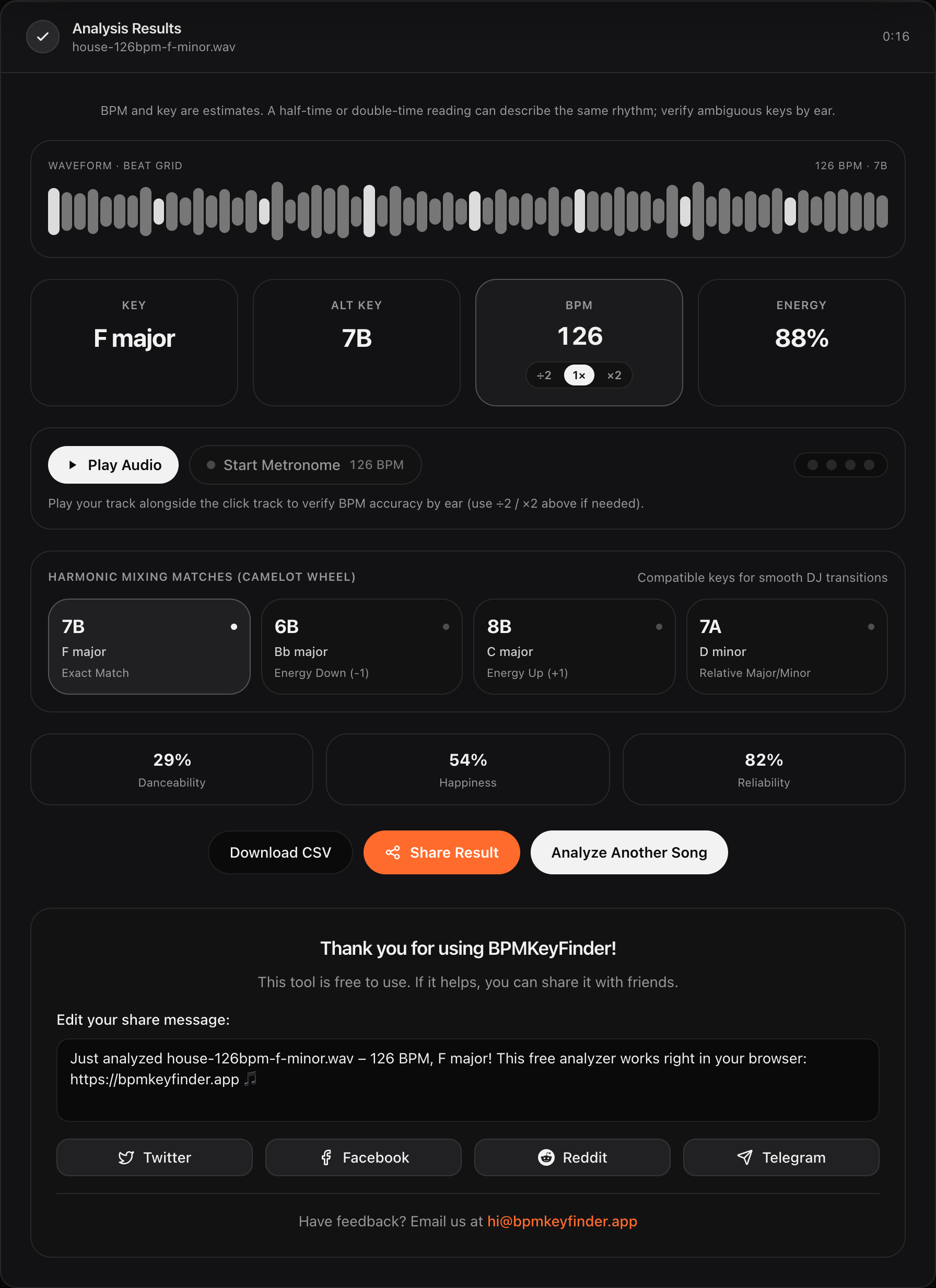
Here is what we actually measured across 4 test tracks in a single batch (1.89 seconds total for all 4 files):
| Test File | Analysis Time | Detected BPM | Detected Key & Camelot | Reliability | Hands-On Observation |
|---|---|---|---|---|---|
house-126bpm-f-minor.wav | 752 ms | 126 BPM | F major (7B) | 82% | Exact BPM & root note F; static triad pad leaned parallel major |
lofi-85bpm-c-major.wav | 612 ms | 86 BPM | C major (8B) | 87% | Exact key 8B & Camelot matches (7B / 9B / 8A) |
trap-140bpm-a-minor-halftime.wav | 807 ms | 140 BPM | A major (11B) | 82% | Exact BPM & root A; verify minor vs. parallel major by ear |
dnb-174bpm-d-minor.wav | 607 ms | 87 BPM (×2 = 174) | D major (10B) | 82% | Half-time BPM corrected with one click on ×2 |
What This Real Test Teaches You
Automated key detectors—including Essentia.js, Rekordbox, and Mixed In Key—excel at locking onto the root tonal center (4/4 exact root matches above) and clear major progressions (C major 8B hit 87% reliability). However, on minimal synth pads or bass-heavy tracks where strong 2nd/3rd harmonics mask the minor third, any algorithm can flip between parallel major/minor (e.g., F minor 4A vs. F major 7B) or relative major/minor (8A vs. 8B).
That is why BPMKeyFinder displays both the Reliability score and an inline Play Audio button right next to the Camelot match cards: trust scores above 80% as your starting point, and always cue the transition in your headphones for 4 bars before pushing the fader.
Complete 24-Key Camelot Reference Chart
| Camelot | Minor (Inner A) | Camelot | Major (Outer B) |
|---|---|---|---|
| 1A | A♭ minor (G♯m) | 1B | B major |
| 2A | E♭ minor (D♯m) | 2B | F♯ major (G♭) |
| 3A | B♭ minor (A♯m) | 3B | D♭ major (C♯) |
| 4A | F minor | 4B | A♭ major (G♯) |
| 5A | C minor | 5B | E♭ major (D♯) |
| 6A | G minor | 6B | B♭ major (A♯) |
| 7A | D minor | 7B | F major |
| 8A | A minor | 8B | C major |
| 9A | E minor | 9B | G major |
| 10A | B minor | 10B | D major |
| 11A | F♯ minor (G♭m) | 11B | A major |
| 12A | D♭ minor (C♯m) | 12B | E major |
Recommended Prep Workflow
- Batch-analyze your crate: Drop up to 20 local tracks into BPMKeyFinder and export the CSV for Rekordbox, Serato, or Traktor.
- Plan transitions visually: Open the Interactive Camelot Wheel and click your opener's key to map a 3–5 track energy arc (
8A → 8A → 9A → 10A → 10B). - Sync your FX: If you run external delay or reverb sends during transitions, grab exact millisecond times from our BPM to MS Calculator.
About BPMKeyFinder Audio Team
Audio engineering and DJ workflow specialists building fast, privacy-first browser tools.
https://bpmkeyfinder.app