
BPM Ranges by Music Genre (2026 Chart + Real 4-Genre Batch Analysis Test)
7 min read
by BPMKeyFinder Audio Team
BPM by GenreDJ PrepBatch AnalysisHands-On Test
Complete BPM Reference Chart by Music Genre
Knowing typical genre BPM ranges does two things immediately: it helps you spot half-time / double-time detection errors on sight, and it lets you plan realistic tempo ramps across a DJ set or workout playlist without pitching tracks into chipmunk territory.
| Music Genre | Typical BPM Range | Sweet Spot | Common Half/Double Pair |
|---|---|---|---|
| Ambient / Downtempo | 60 – 90 BPM | 75 BPM | 150 BPM |
| Lo-fi / Boom-Bap Hip-Hop | 75 – 95 BPM | 85 BPM | 170 BPM |
| R&B / Reggaeton / Moombahton | 88 – 108 BPM | 96 BPM | — |
| Pop / Synth-Pop / Disco | 105 – 122 BPM | 118 BPM | — |
| Deep House / Tech House | 120 – 128 BPM | 124–126 BPM | — |
| Melodic Techno / Peak Techno | 128 – 142 BPM | 132–136 BPM | — |
| Trance / Psytrance | 134 – 145 BPM | 138 BPM | — |
| Trap / Dubstep / Grime | 138 – 150 BPM | 140 BPM | 70 BPM (half-time) |
| Hardstyle / UK Hardcore | 150 – 170 BPM | 155 BPM | 75–85 BPM |
| Drum & Bass / Jungle | 168 – 178 BPM | 174 BPM | 87 BPM (half-time) |
Real Hands-On Batch Test: 4 Genres Analyzed in 1.89 Seconds
Instead of checking tracks one by one, DJs usually prep an entire crate at once. We dropped 4 synthesized genre test files—Lo-fi (85 BPM), House (126 BPM), Trap (140 BPM), and Drum & Bass (174 BPM)—into BPMKeyFinder simultaneously in Chrome:
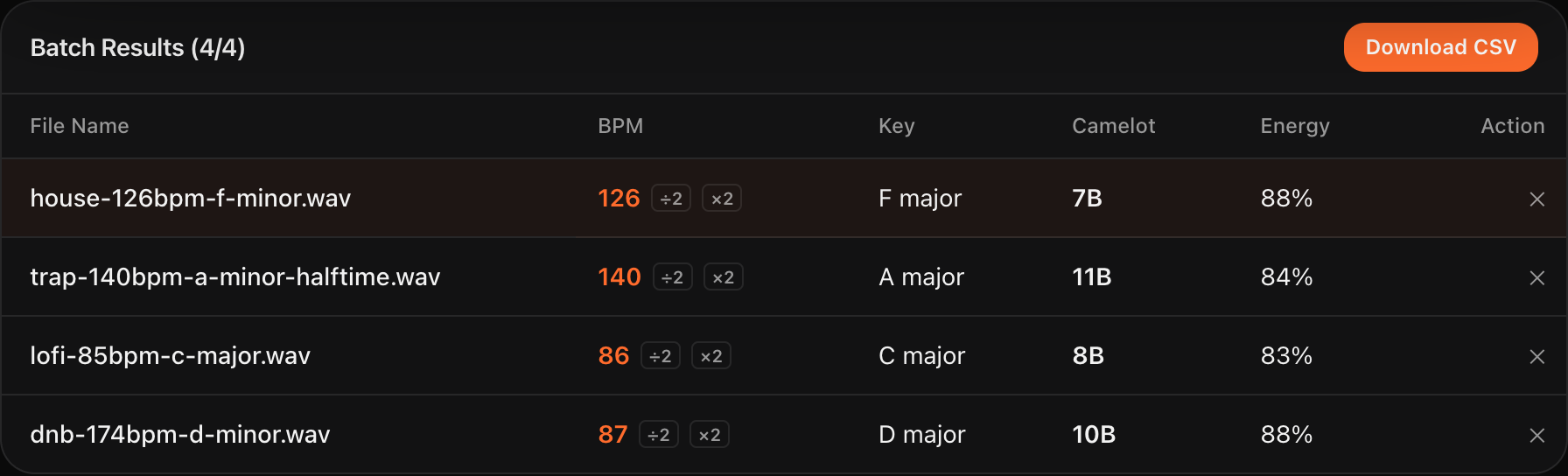
Measured Benchmark Results
- Total batch time (4 × 16s WAV files): 1,890 ms (~0.47 s per track)
- Network upload: 0 bytes (100% local Essentia.js WASM in Chrome)
- Per-row half/double correction: Every row in the batch table includes inline
÷2and×2buttons—clicking×2ondnb-174bpm-d-minor.wavupdates87 → 174 BPMbefore you hit Download CSV. - CSV export columns:
File Name, BPM, Key, Camelot, Energy, Danceability, Happiness, Reliability, Duration—ready for Excel, Notion, or Rekordbox/Serato prep sheets.
Practical Tempo-Transition Rules for DJs
- Stay within ±4% to ±6% pitch range for smooth blends: At 124 BPM, ±5% gives you roughly 118–130 BPM. Beyond ±8%, vocals start to sound stretched even with Master Tempo / Key Lock enabled.
- Use half-time bridges to jump genres cleanly: Jumping from 87 BPM Hip-Hop straight into 174 BPM Drum & Bass (or 70 BPM R&B into 140 BPM Dubstep) requires zero pitch shift because the beat grids align 2:1.
- Pair BPM ramps with Camelot moves: Once your batch CSV is sorted by BPM, open our Interactive Camelot Wheel to chain compatible keys (
±1orA↔B) along the ramp. - No audio file on hand? Use Tap Tempo for vinyl/streaming or Live Mic BPM for live speakers.
About BPMKeyFinder Audio Team
Audio engineering and DJ workflow specialists building fast, privacy-first browser tools.
https://bpmkeyfinder.app